A.8. Beta-Elemene, ELE
Molecular weight: 204.36
Aromas: grassy, waxy, fresh
Alternative sources: Curcuma wenyujin (zedoary), black cumin (Nigella)
Commercial essential oils (trace amounts): Cymbopogon winterianus (2%), Cananga odorata (1%)
β‑ELE is a highly practical anticancer agent in traditional Chinese medicine, administered as the herb Rhizoma Zedoariae. It is now regarded in China as an official, licensed, Western‑type drug and is given both orally and intravenously. It has also been investigated in preclinical and small clinical studies. Its properties include antiproliferative activity, inhibition of cell‑cycle progression, antiangiogenic effects, and induction of apoptosis in cancers of the lung, prostate, ovary, glioblastoma, leukemia, and melanoma [indicatively, Wang et al. (2005), Li et al. (2005), Yao et al. (2008), Li et al. (2010), Yu et al. (2011), Chen et al. (2011)]. The principal signaling pathways affected are inhibition of MAPK/ERK and PI3K/Akt/mTORC1 (Jiang et al., 2016).
β‑ELE acts synergistically with temozolomide by enhancing its penetration into the brain and increasing the sensitivity of glioblastoma stem‑like cells to this agent [Zhao et al. (2012), Zhu et al. (2014), Zhang et al. (2021)]. It also acts synergistically with platinum derivatives in the treatment of glioblastoma, oral squamous cell carcinoma, and hepatocellular carcinoma, sensitizes melanoma to radiotherapy (indicatively, Tong et al., 2020), and reverses established chemoresistance (Tan et al., 2021).
The antineoplastic utility of β‑ELE in combination with chemotherapy has been confirmed by a large meta‑analysis in lung cancer, hepatocellular carcinoma, brain metastases, and leukemia, but not in gastric cancer (Xu et al., 2013). In another meta‑analysis, β‑ELE emerged as a safe and effective agent in combination with platinum derivatives for stage III/IV non‑small‑cell lung cancer, with additional improvements in cellular immunity, reversal of established chemoresistance, and reduction of platinum toxicity (Wang et al., 2019). Reversal of chemoresistance, however, has an obvious corollary: the possibility of toxicity due to high intracellular concentrations of paclitaxel, colchicine, and vinblastine (Zhang et al., 2015).
The concentrations of β‑ELE required to produce all of the effects described cannot be achieved through cannabis alone. If synergy with β‑ELE is desired, it must be added as a separate preparation. The mechanisms of caspase activation by elemene are depicted in Figure 25.
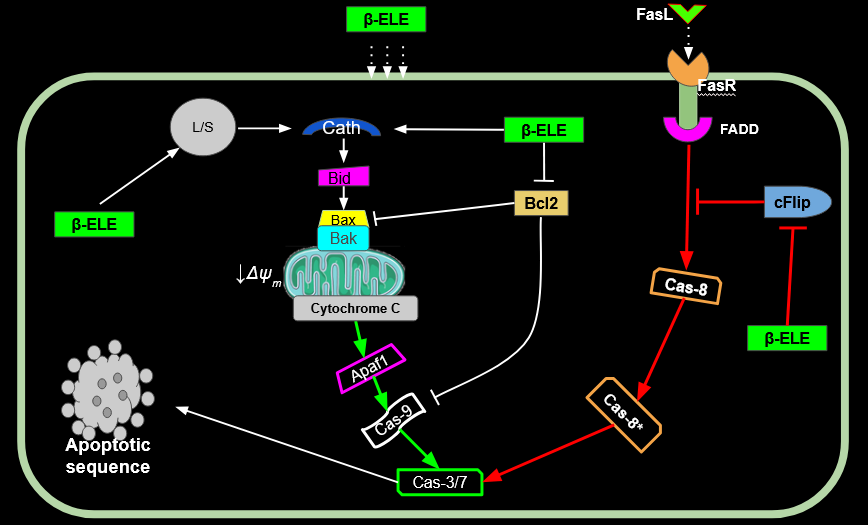
Figure 25. Biochemical pathways leading to autophagy and apoptosis under the influence of β‑ELE. β‑ELE can induce apoptosis, depending on the cancer cell type, either by activating the extrinsic pathway (caspase‑8 cascade), by engaging the intrinsic mitochondrial pathway, or by altering the redox state of the cell through inhibition of glutathione synthesis (Jiang et al., 2016). Activation of the extrinsic apoptotic pathway by cathepsins is not depicted here.
β‑ELE: β‑elemene; FasR and FasL: Fas receptor and ligand1; FADD2: death‑domain adaptor protein; Apaf‑1: apoptotic protease activating factor‑1 of the mitochondrial pathway; Cas: various caspases; cFLIP3: an antiapoptotic factor; Cath: cathepsins4; L/S: lysosome; Bax/Bak5: proapoptotic complex; Bid6: activator of Bax/Bak; Bcl‑27: antiapoptotic factor.